


For years I've done BI enablement consulting and have regularly referenced the Gartner Magic Quadrant when commenting on trends and opportunities within the BI space, so I decided to take a deep dive into the last 20 years of the Quadrant.
I found some very interesting trends and insights to say the least. Ever wondered why some BI platforms stay on the Quadrant well past what feels like their prime? Or why some big names seemingly vanish? Here are 4 of my key findings.
1. EVERY VENDOR, YEAR BY YEAR
This seems self explanatory, but from 2005 to 2024, big platforms (Microsoft, AWS, Google, Salesforce, Oracle, SAP, Alibaba, IBM, SAS) dominated the Magic Quadrant. Some of them were homegrown but many were via acquisition:
ProClarity → Microsoft (2006)
Cognos → IBM (2007)
Hyperion → Oracle (2007)
Business Objects → SAP (2007)
Tableau → Salesforce (2019)
Looker → Google (2020)
2. ENTRY IS ROUGH
My next bit of analysis focused on where new platforms start their Gartner Magic Quadrant journey. As expected, new tools are generally not given high status on the Quadrant. See a few insights I found below:
Ten of last 12 new BI tools started in the Niche category
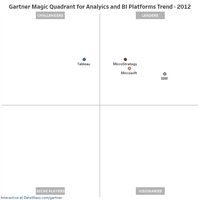
Tableau had the highest debut as a Challenger
Qlik's low rating in its debut is interesting given its current market share
The visual below displays where all tools on the 2024 Quadrant debuted, with the exception of the tools that were on the MQ prior to 2004 (Microsoft, SAS, SAP, IBM, MicroStrategy, Spotfire).
3. NO RECENT CHANGES
The years 2010 thru 2012 saw an explosion of new BI tools with 10 new companies entering the Quadrant, but as of 2024 - only Tableau remains.
The least amount of change has been in the last two years with no new companies being added to the Quadrant. With so many changes in the industry happening, my guess is that there will be some new names this year. My best guesses are:
Sigma Computing - now marketing themselves as a BI platform instead of just a BI tool with their write-back functionality. They've also been strong with integrating into modern cloud data architecture so I would expect to see them on there this year. Probably not as a Leader, but as a Niche Player (where most platforms start).
Databricks: Databricks continue to expand beyond traditional CDW and data science use cases with their AI BI tool. The tool is integrated with the Databricks Lakehouse and positioned as a natural extension of their unified platform. Similar to Sigma, it's likely that if they do end up on the Quadrant this year it will be as a Niche Player.
4. WHO’S NEXT TO FALL?
Churn is natural in all business cycles, and the current field of BI tools is no different. Churn generally happens most with Niche players, though occasionally a Visionary gets the boot. If I were a betting man, I'd bet on the following tools to be the biggest candidates to be left off this year's list:
Sisense: Its 2022 mass layoffs disrupted development momentum - its placement in the Magic Quadrant reflects this.
Spotfire: Split out from TIBCO in 2023. Feels slower in innovation - if any.
Incorta: More focused on their lake-house vision. Feels a bit out of place overall. They’ve got three straight years as a Niche Player but little progress in the magic quadrant.
What do you think? Drop your hot takes below!
Videos
I’m looking into different BI platforms and wanted to find the best one. Any advice? Pros and cons?
Would love to know if you rely on word-of-mouth / other data peers' insights, G2, google search, certain Slack communities or any specific resources (newsletters)? Thanks for your help!
And this doesn’t even include Arun and Amir’s Microsoft Build Analytics “vNext” announcement ;)
Read the report here: https://www.qlik.com/us/gartner-magic-quadrant-business-intelligence
Thoughts on the results?
Microsoft and Tableau vs all others. I do feel like most others, including Looker, are niche players with none really gaining enough market share to make the top two sweat. Microsoft's strength is really the completeness of platform (data+viz) where Tableau has been trying bolt on pieces over time.
I think it's too bad that there isn't more competition as I feel like innovation in BI is stalling. Overall BI is becoming commoditized while adjacent Data Engineering and Data Science/Analytics are surging.
Some of the up-and-comers have interesting approaches. I'd like to see more around.
-
Multi-channel BI (portal, push, stream)
-
BI/Data API interfaces (not strictly reporting/viz)
-
GraphDB support
-
More robust cross datasource joining (more like data federation including db, nosql/json, api)
-
Real-time reporting
-
Context aware embedded BI
As a side note I find it sad that MicroStrategy is investing $300M in Bitcoin. It's like seeing your Uncle get hooked on meth.
The companies that list links to the Magic Quadrant have all paid a lot of money for this privilege. They also pay a lot of money for cross-marketing services that Gartner and the many brands (Capterra, SoftwareAdvice, GetApp, and more) they own provide.
Second, they make money by writing about hot topics like AI, ML, Big Data, etc., even when only 1% of BI implementations utilize these. Boring old BI best-practices (e.g. user adoption, semantic modeling, etc.) do not get much clicks.
With that, I do think the analysis is pretty good. Microsoft's ability to execute is solid, however I would say it's not visionary - there aren't many/any features that many of the traditional BI providers have. Tableau is awesome, but not "enterprise-BI", meaning there are few medium+ organizations that can use it as their main BI tool. Qlik has excellent ability to execute, but is really old tech under the covers. They were bought by private equity firms that are milking it's value until they retire it - oldest trick in the private equity book. Having used Yellowfin, it should probably be higher. Oracle should be dead last. IBM should be lower on ability to execute, but much higher on completeness of vision. One of my main critiques is that IBM Cognos tries to do too much, making it inaccessible to regular users.
I'm looking through some Gartner reports for a project we're working on, like I've done many times before. I'm looking for other opinions on here. But, I feel these reports are a way for management to justify their jobs and the Magic Quadrant is a little bit like Motor Trend Car of the Year (Make with the most money wins).
I feel like I'm a reasonably intelligent person, but when I read these reports I have to re-read a paragraph three times just to comprehend what it's saying.
Please tell me I'm not the only one.
This report is normally published in February of each year. Do any 'In The Know' users know why the report seems to be delayed at least several weeks? Any current controversies? Is it going through a lengthy customer input/editing process? I know one has to take it with a grain of salt but it does help drive Enterprise user awareness, comparisons to existing analytics tool sets. I will try to post to my organization using MS Teams.
What do you guys think about this?