


It's not that you're actually getting extra precision - it's that the float didn't accurately represent the number you were aiming for originally. The double is representing the original float accurately; toString is showing the "extra" data which was already present.
For example (and these numbers aren't right, I'm just making things up) suppose you had:
float f = 0.1F;
double d = f;
Then the value of f might be exactly 0.100000234523. d will have exactly the same value, but when you convert it to a string it will "trust" that it's accurate to a higher precision, so won't round off as early, and you'll see the "extra digits" which were already there, but hidden from you.
When you convert to a string and back, you're ending up with a double value which is closer to the string value than the original float was - but that's only good if you really believe that the string value is what you really wanted.
Are you sure that float/double are the appropriate types to use here instead of BigDecimal? If you're trying to use numbers which have precise decimal values (e.g. money), then BigDecimal is a more appropriate type IMO.
It's not that you're actually getting extra precision - it's that the float didn't accurately represent the number you were aiming for originally. The double is representing the original float accurately; toString is showing the "extra" data which was already present.
For example (and these numbers aren't right, I'm just making things up) suppose you had:
float f = 0.1F;
double d = f;
Then the value of f might be exactly 0.100000234523. d will have exactly the same value, but when you convert it to a string it will "trust" that it's accurate to a higher precision, so won't round off as early, and you'll see the "extra digits" which were already there, but hidden from you.
When you convert to a string and back, you're ending up with a double value which is closer to the string value than the original float was - but that's only good if you really believe that the string value is what you really wanted.
Are you sure that float/double are the appropriate types to use here instead of BigDecimal? If you're trying to use numbers which have precise decimal values (e.g. money), then BigDecimal is a more appropriate type IMO.
I find converting to the binary representation easier to grasp this problem.
float f = 0.27f;
double d2 = (double) f;
double d3 = 0.27d;

System.out.println(Integer.toBinaryString(Float.floatToRawIntBits(f)));
System.out.println(Long.toBinaryString(Double.doubleToRawLongBits(d2)));
System.out.println(Long.toBinaryString(Double.doubleToRawLongBits(d3)));
You can see the float is expanded to the double by adding 0s to the end, but that the double representation of 0.27 is 'more accurate', hence the problem.
   111110100010100011110101110001
11111111010001010001111010111000100000000000000000000000000000
11111111010001010001111010111000010100011110101110000101001000
java - Why converting from float to double changes the value? - Stack Overflow
How float is converted to double in java? - Stack Overflow
java - How to round a float value to double value? - Stack Overflow
[New CS Student]Trouble differentiating between floats and doubles--why is 23.5 considered a double?
The value of a float does not change when converted to a double. There is a difference in the displayed numerals because more digits are required to distinguish a double value from its neighbors, which is required by the Java documentation. That is the documentation for toString, which is referred (through several links) from the documentation for println.
The exact value for 125.32f is 125.31999969482421875. The two neighboring float values are 125.3199920654296875 and 125.32000732421875. Observe that 125.32 is closer to 125.31999969482421875 than to either of the neighbors. Therefore, by displaying “125.32”, Java has displayed enough digits so that conversion back from the decimal numeral to float reproduces the value of the float passed to println.
The two neighboring double values of 125.31999969482421875 are 125.3199996948242045391452847979962825775146484375 and 125.3199996948242329608547152020037174224853515625.
Observe that 125.32 is closer to the latter neighbor than to the original value (125.31999969482421875). Therefore, printing “125.32” does not contain enough digits to distinguish the original value. Java must print more digits in order to ensure that a conversion from the displayed numeral back to double reproduces the value of the double passed to println.
- When you convert a
floatinto adouble, there is no loss of information. Everyfloatcan be represented exactly as adouble. - On the other hand, neither decimal representation printed by
System.out.printlnis the exact value for the number. An exact decimal representation could require up to about 760 decimal digits. Instead,System.out.printlnprints exactly the number of decimal digits that allow to parse the decimal representation back into the originalfloatordouble. There are moredoubles, so when printing one,System.out.printlnneeds to print more digits before the representation becomes unambiguous.
This is a question of formatting above anything else.
Take a look at the Float.toString documentation (Float.toString is what's called to produce the decimal representations you see for the floats, and Double.toString for the double):
How many digits must be printed for the fractional part of m or a? There must be at least one digit to represent the fractional part, and beyond that as many, but only as many, more digits as are needed to uniquely distinguish the argument value from adjacent values of type
float. That is, suppose that x is the exact mathematical value represented by the decimal representation produced by this method for a finite nonzero argument f. Then f must be the float value nearest to x; or, if twofloatvalues are equally close to x, then f must be one of them and the least significant bit of the significand of f must be 0.
(emphasis mine)
The situation is the same for Double.toString. But, you need more digits to "uniquely distinguish the argument value from adjacent values of type double" than you do for float (recall that double is 64-bits while float is 32), that's why you're seeing the extra digits for double and not for float.
Note that anything that can be represented by float can also be represented by double, so you're not actually losing any precision in the conversion.
Of course, not all numbers can be exactly representable by float or double, which is why you see those seemingly random extra digits in the decimal representation in the first place. See "What Every Computer Scientist Should Know About Floating-Point Arithmetic".
The reason why there's such issue is because a computer works only in discrete mathematics, because the microprocessor can only represent internally full numbers, but no decimals. Because we cannot only work with such numbers, but also with decimals, to circumvent that, decades ago very smart engineers have invented the floating point representation, normalized as IEEE754.
The IEEE754 norm that defines how floats and doubles are interpreted in memory. Basically, unlike the int which represent an exact value, the floats and doubles are a calculation from:
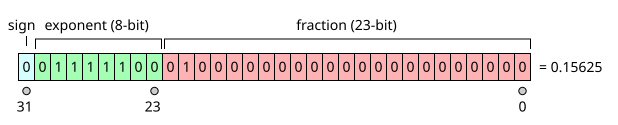
- sign
- exponent
- fraction
So the issue here is that when you're storing 1.2 as a double, you actually store a binary approximation to it:
00111111100110011001100110011010
which gives you the closest representation of 1.2 that can be stored using a binary fraction, but not exactly that fraction. In decimal fraction, 12*10^-1 gives an exact value, but as a binary fraction, it cannot give an exact value.
(cf http://www.h-schmidt.net/FloatConverter/IEEE754.html as I'm too lazy to do it myself)
when I store 1.2 in a double variable 'y' it becomes 1.200000025443 something
well actually in both the float and the double versions of y, the value actually is 1.2000000476837158, but because of the smaller mantissa of the float, the value represented is truncated before the approximation, making you believe it's an exact value, whereas in the memory it's not.
Yes, use
double d = 0.7D;
Using F means it's a float constant, and then it's promoted to double and may not be the closest number to 0.7 that can be represented with a double precision floating point, as the mantissa is not extended in any way.
0.7D is a double constant to begin with.
If you know what precision you want you can round it to say 6 decimal places. eg.
public static double round6(double x) {
    return Math.round(x * 1e6) / 1e6;
}

round6(0.7f) == 0.7
The fact the x passed in was a float doesn't matter provided this precision is suitable.
From my textbook:
When you write a floating-point literal in your program code, Java assumes it to be of the double data type. A double value is not compatible with a float variable because a double can be much larger or smaller than the allowable range for a float. As a result, code such as the following will cause an error:
Example 1:
float number;
number = 23.5;       //Error!
You can force a double to be treated as a float, by suffixing it with the letter F or f. The preceding code can be rewritten in the following manner to prevent an error:
Example 2:
float number;
number = 23.5F;       //This will work.

===================================================
I can't figure out why example 1 produces an error. Why is 23.5 considered a double? I thought it was a float.
AFAIK, float numbers are precise up to 7 decimal digits of accuracy. 23.5 only has 1 decimal digit. What am I not understanding? I thought by typing 'float number;' you are declaring the number variable to be a float. Why would you need the extra step of adding an F?
Thanks