


# Over-explaining a bit:
def magic(numList):         # [1,2,3]
    s = map(str, numList)   # ['1','2','3']
    s = ''.join(s)          # '123'
    s = int(s)              # 123
    return s


# How I'd probably write it:
def magic(numList):
    s = ''.join(map(str, numList))
    return int(s)


# As a one-liner
num = int(''.join(map(str,numList)))


# Functionally:
s = reduce(lambda x,y: x+str(y), numList, '')
num = int(s)


# Using some oft-forgotten built-ins:
s = filter(str.isdigit, repr(numList))
num = int(s)
Two solutions:
>>> nums = [1, 2, 3]
>>> magic = lambda nums: int(''.join(str(i) for i in nums)) # Generator exp.
>>> magic(nums)
123
>>> magic = lambda nums: sum(digit * 10 ** (len(nums) - 1 - i) # Summation
...     for i, digit in enumerate(nums))
>>> magic(nums)
123
The map-oriented solution actually comes out ahead on my box -- you definitely should not use sum for things that might be large numbers:
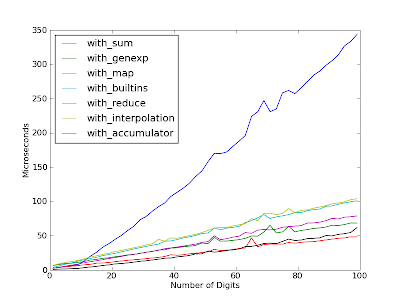
import collections
import random
import timeit

import matplotlib.pyplot as pyplot

MICROSECONDS_PER_SECOND = 1E6
FUNS = []
def test_fun(fun):
    FUNS.append(fun)
    return fun

@test_fun
def with_map(nums):
    return int(''.join(map(str, nums)))

@test_fun
def with_interpolation(nums):
    return int(''.join('%d' % num for num in nums))

@test_fun
def with_genexp(nums):
    return int(''.join(str(num) for num in nums))

@test_fun
def with_sum(nums):
    return sum(digit * 10 ** (len(nums) - 1 - i)
        for i, digit in enumerate(nums))

@test_fun
def with_reduce(nums):
    return int(reduce(lambda x, y: x + str(y), nums, ''))

@test_fun
def with_builtins(nums):
    return int(filter(str.isdigit, repr(nums)))

@test_fun
def with_accumulator(nums):
    tot = 0
    for num in nums:
        tot *= 10
        tot += num
    return tot

def time_test(digit_count, test_count=10000):
    """
    :return: Map from func name to (normalized) microseconds per pass.
    """
    print 'Digit count:', digit_count
    nums = [random.randrange(1, 10) for i in xrange(digit_count)]
    stmt = 'to_int(%r)' % nums
    result_by_method = {}
    for fun in FUNS:
        setup = 'from %s import %s as to_int' % (__name__, fun.func_name)
        t = timeit.Timer(stmt, setup)
        per_pass = t.timeit(number=test_count) / test_count
        per_pass *= MICROSECONDS_PER_SECOND
        print '%20s: %.2f usec/pass' % (fun.func_name, per_pass)
        result_by_method[fun.func_name] = per_pass
    return result_by_method

if __name__ == '__main__':
    pass_times_by_method = collections.defaultdict(list)
    assert_results = [fun([1, 2, 3]) for fun in FUNS]
    assert all(result == 123 for result in assert_results)
    digit_counts = range(1, 100, 2)
    for digit_count in digit_counts:
        for method, result in time_test(digit_count).iteritems():
            pass_times_by_method[method].append(result)
    for method, pass_times in pass_times_by_method.iteritems():
        pyplot.plot(digit_counts, pass_times, label=method)
    pyplot.legend(loc='upper left')
    pyplot.xlabel('Number of Digits')
    pyplot.ylabel('Microseconds')
    pyplot.show()
Hi, I'm trying to solve this leetcode style problem. Here is the problem. Given a number, return the intermediate values before it reaches Kaprekar's constant, 6174.
Here are the steps:
Arrange the digits in increasing and decreasing order, giving you two numbers
- Subtract the smaller number from the larger number
- Repeat the above steps until the result is 6174
I keep getting an error on my list comprehensions when I'm trying to turn a list into an int. Any help of advice you can give me would be greatly helpful!
def solve(num):
    while num != 0:
        digit_string = str(num)
        digit_map = map(int, digit_string)
        list1 = list(digit_map)
        list1.sort(reverse=True)
        list2 = list1.copy()
        list2.sort()

        num1 = int(str(list1))
        num2 = int(str(list2))
        result = list1 - list2

        if result == 6174:
            return num1, num2
        else:
            return solve(num1)

num = 1234
print(solve(num))What i want to say is that how can we turn a list/ array like [1,2,3] into a number like 123 also i would love to know how can we turn it back to list.
If you can share the code and explain it would be appreciated.
suppose i have a list full of strings:
list = ["m", "s", "o", "23", "1", "k", "2"]
and i want to take this list and convert all digits into int and keep the string, i tried using:
new_list = [int(val) for val in list if val.isdigit()]
but it throws away all non-digit strings, is there a list comprehension solution to this problem? I know how to solve it using regular for loops but i am trying to avoid that, thanks!
Convert the integer to string first, and then use map to apply int on it:
>>> num = 132
>>> map(int, str(num))    #note, This will return a map object in python 3.
[1, 3, 2]
or using a list comprehension:
>>> [int(x) for x in str(num)]
[1, 3, 2]
There are already great methods already mentioned on this page, however it does seem a little obscure as to which to use. So I have added some mesurements so you can more easily decide for yourself:
A large number has been used (for overhead) 1111111111111122222222222222222333333333333333333333
Using map(int, str(num)):
import timeit

def method():
    num = 1111111111111122222222222222222333333333333333333333
    return map(int, str(num))

print(timeit.timeit("method()", setup="from __main__ import method", number=10000)
Output: 0.018631496999999997
Using list comprehension:
import timeit
def method():
    num = 1111111111111122222222222222222333333333333333333333
    return [int(x) for x in str(num)]

print(timeit.timeit("method()", setup="from __main__ import method", number=10000))
Output: 0.28403817900000006
Code taken from this answer
The results show that the first method involving inbuilt methods is much faster than list comprehension.
The "mathematical way":
import timeit

def method():
    q = 1111111111111122222222222222222333333333333333333333
    ret = []
    while q != 0:
        q, r = divmod(q, 10) # Divide by 10, see the remainder
        ret.insert(0, r) # The remainder is the first to the right digit
    return ret

print(timeit.timeit("method()", setup="from __main__ import method", number=10000))
Output: 0.38133582499999996
Code taken from this answer
The list(str(123)) method (does not provide the right output):
import timeit

def method():
    return list(str(1111111111111122222222222222222333333333333333333333))

print(timeit.timeit("method()", setup="from __main__ import method", number=10000))
Output: 0.028560138000000013
Code taken from this answer
The answer by Duberly González Molinari:
import timeit

def method():
    n = 1111111111111122222222222222222333333333333333333333
    l = []
    while n != 0:
        l = [n % 10] + l
        n = n // 10
    return l

print(timeit.timeit("method()", setup="from __main__ import method", number=10000))
Output: 0.37039988200000007
Code taken from this answer
Remarks:
In all cases the map(int, str(num)) is the fastest method (and is therefore probably the best method to use). List comprehension is the second fastest (but the method using map(int, str(num)) is probably the most desirable of the two.
Those that reinvent the wheel are interesting but are probably not so desirable in real use.